
The style manual published by the Council of Biology Editors (CBE)— Scientific Style and Format: The CBE Manual for Authors, Editors, and Publishers, 6th ed. —is the basic guide for most writing in the life sciences and medicine. In addition to extensive treatment of the conventions for scientific terminology, it presents two systems of documenting references: a name-year system similar to that of APA and a citation-sequence system, which uses superscript numbers in the text that refer to a numbered list of references. (Some scientific journals use some variant of one of these systems, such as citation numbers enclosed in parentheses in the line of text rather than above it; check with your instructor about the preferred citation system for your class.)
The major difference between the CBE system of numbered notes and that of The Chicago Manual is that the references in CBE are assigned a number by order of the first mention in the paper and the number is repeated whenever that reference is cited in the paper. In general, the goal of the CBE style for entries in the reference list is to minimize the number of keystrokes made by the typist: there are no periods after initials; names of journals and publishers are abbreviated; neither italics nor quotation marks are used with titles of books, journals, or articles.
CBE Numbered List of References
1. Book with One or More Authors
2. Book with One or More Editors
3. Book with an Organization as Author
4. Book without an Author or Editor Named
5. Book Edition Other Than the First
7. Volume in a Multivolume Series
8. Chapter or Part of Book by Author of Book
9. Chapter or Part of Book Not by Author or Editor of Book
11. Article by Organizational Author
12. Article on Discontinuous Pages
13. Article in a Journal Paginated by Issue
14. Article in a Supplement to an Issue
16. Magazine Article
18. Scientific or Technical Report
21. Electronic Journal Article
22. Electronic Book or Monograph
Superscript numbers in the text refer to numbered references in the reference list at the end of the paper. References are numbered according to the order in which they are first used in the text. Thus, the first reference cited is 1, the second is 2, and so on. Each time the reference numbered 1 \s e\ie.d \n d\<t text, the superscript 1 is used. Two or more citation numbers in one place should be separated by a comma; a sequence of three or more citation numbers, however, should be treated as an inclusive number separated by a hyphen (such as “2-4”) rather than as a series (that is, “2,3,4”). The numbers are placed at the point of citation rather than at the end of a sentence or a clause as is the custom for The Chicago Manual, MLA, and APA styles.
The two prime factors most frequently cited 1 - 2 are evolutionary history and mode of transmission.
The superscript numbers in this example would correspond to entries 1 and 2 of the paper's reference list.
CBE Numbered List of References
The reference list, which begins on a new page after the end of the text, should be titled “References” or “Cited References.” (Sources that were consulted but are not cited in the text may be listed under a separate heading, such as “Additional References” or “Bibliography”) The entries are numbered sequentially according to their first mention in the text.
The basic order of elements in a reference entry is the name of the author or authors, the title of the book or article, publication information, and pages. Each element ends with a period; periods are not used after initials or abbreviations. A comma is used to separate items of equal importance, such as authors’ names. A semicolon is used to separate items that are parts of an element but are not directly related, such as the date of publication of a journal and the volume number or the publisher of a book and the year of publication. A colon indicates that what follows is subordinate to the material before it, such as a subtitle or the page numbers following the volume number of a journal. Examples of the most common kinds of references are shown here and explained in more detail in The CBE Manual; for more specialized examples, consult the National Library of Medicine Recommended Formats for Bibliographic Citation, which is the primary source of CBE citation style.
Books. The formats described here can apply to booklets, pamphlets, and brochures as well as to books.

1. Book with one or more authors. The names of all authors are reversed. If there are more than ten authors, the first ten are listed, followed by “and others.” First initials rather than first names are used in most cases. No periods are used after’ the initials, and no comma is used between the last name and the initials.

Only the first word, proper nouns, proper adjectives, and capitalized abbreviations (such as AIDS) are capitalized in the title. In contrast to the APA, documentation system, which also uses a lowercase style for titles, the first word of a subtitle is not capitalized in CBE bibliographical entries, nor is titles italicized or underlined.
The name of the publisher is usually shortened. Drop conventional commercial designations, such as “Company,” “Inc.,” and “Press,” unless doing so would cause ambiguity. In that case, abbreviate the term—”Pr” for “Press,” for example. (The CBE Manual further explains the rules for shortening publishers’ names and provides a list of examples.) The last element in book entries is the total number of pages in the book (including back-matter, such as the index) followed by “p” (for “pages”).
1. Mandelbrot BB. The fractal geometry of nature. San
Francisco : WH Freeman; 1995. 460 p.
2. Book with one or more editors. Follow the names with the word “editor” (or”editors”).
2. Briggs DEG, Crowther PR, editors. Paleobiology: a synthesis. Cambridge (MA): Blackwell Scientific; 1992. 608 p.
3. Book with an organization as author. Organization names are shortened according to the CBE rules for shortening publishers’ names
3. British Medical Assoc. A code of practice for sterilisation of instruments and control of cross infection. London : British Medical Assoc; 1989. 58 p.
4. Book without an author or editor named. To indicate that no author or editor is listed on the title page or elsewhere, start the entry with “[Anonymous].”
4. [Anonymous]. Social aspects of AIDS prevention and control programmes. Geneva : World Health Organization; 1988. 174 p.
5. Book edition other than the first. Include the edition number in abbreviated form after the title. Use “rev ed” as the abbreviation for “revised edition.”
5. McCurnin DM, editor. Clinical textbook for veterinary technicians. 2nd ed. Philadelphia: WB Saunders; 1993. 816 p.
6. Translated book. Include the name of the translator after the title. If there is an editor in addition to the author, put the editor’s name after the translator’s and separate the two with a semicolon. After the number of pages, the title in the original language may be included.
6. Spindler K. The man in the ice: the discovery of a 5,000-year-old body reveals the secrets of the Stone Age. Osers E, translator. New York : Random House; 1994. 305 p. Translation of: Mann im eis.
7. Volume in a multivolume series. The title of the series precedes the volume number and title of the volume being cited. The total pages of the volume are not necessary.
7. Legendre P, Legendre L, editors. NATO ASI series. Volume G14, Developments in numerical ecology. Berlin : Springer-Verlag; 1989.
8. Chapter or part of book by author of book. The title of the book follows the author’s name. The title of the part (as well as any other pertinent identification, such as the number or type of the part) follows the publication information. The page numbers of the part are the last element in the entry. (Note that in inclusive page numbers, only the changed digits in the second number are shown.)
8. Bakker RT. The dinosaur heresies. New York : Zebra; 1986. The twilight of the dinosaurs; p 442-4.
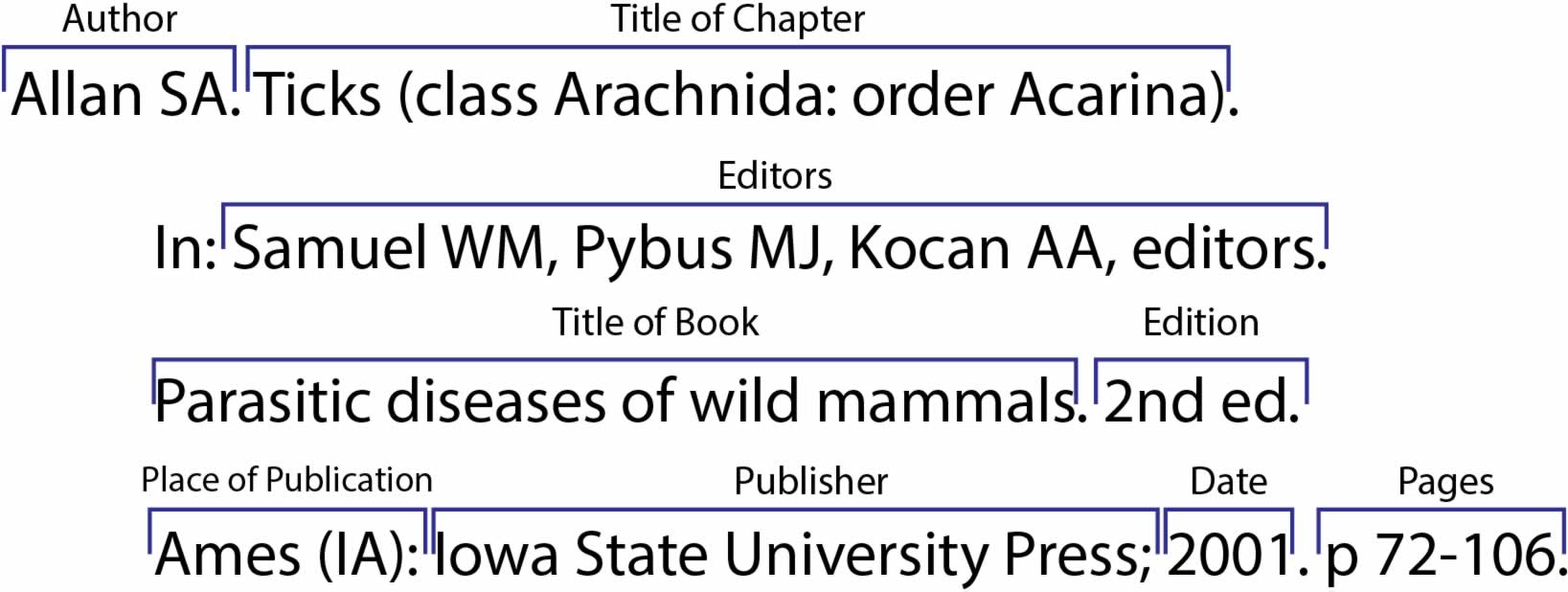
9. Chapter or part of book not by author or editor of book. The entry begins with the name of the author of the part and the title of the part. Then the book is identified. The last element in the entry, following the publication information, is the page numbers of the part.
9. Benton MJ. Red queen hypothesis. In: Briggs DEG, Crowther PR, editors. Paleobiology: a synthesis. Cambridge (MA): Blackwell Scientific; 1992. p 119-23.
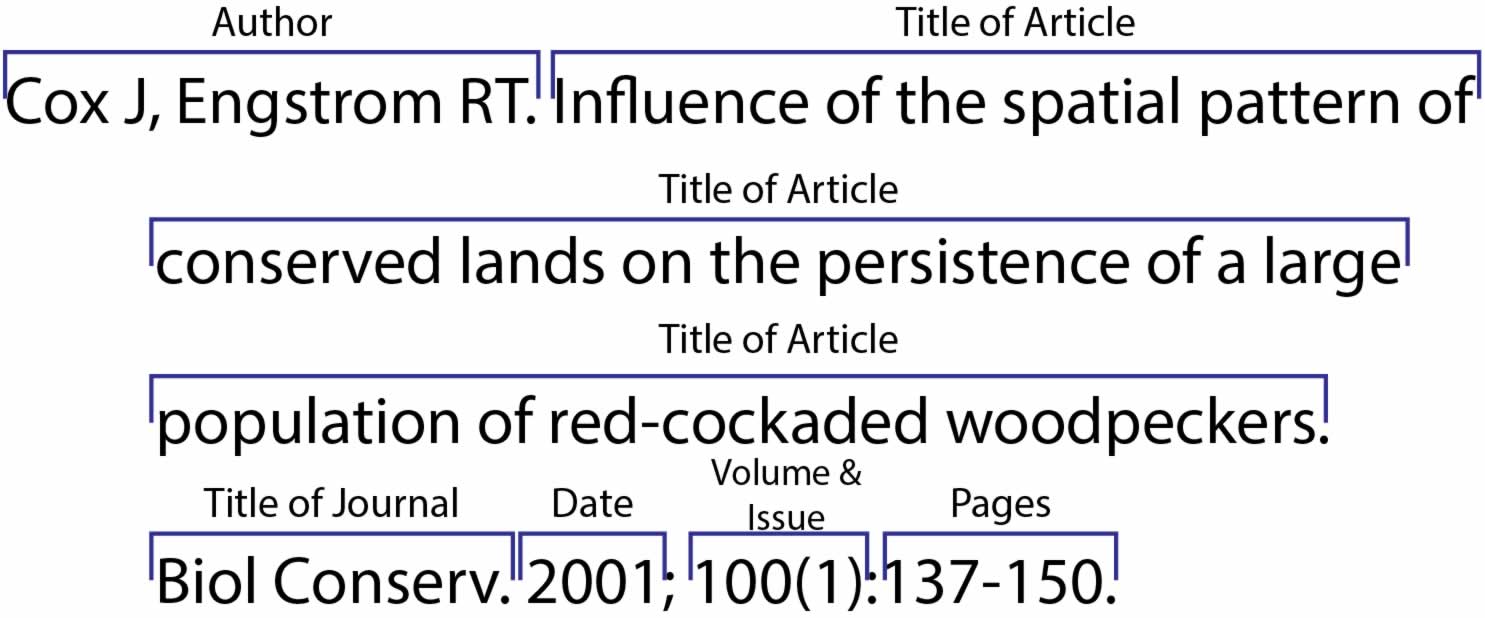
10. Article in a journal. If there are more than ten authors, list the names of the first ten, followed by “and others.” Capitalize only the first word, proper nouns, proper adjectives, and capitalized abbreviations (such as AIDS) in article titles. To indicate a type of article—such as editorial, interview, or letter to the editor—enclose the descriptor in square brackets immediately after the article title.
Journal titles longer than one word are abbreviated according to the standard form used in most biological and medical journals: articles, conjunctions, and prepositions are dropped unless they are part of a name or a scientific or technical term; at least the last two letters of all remaining words are dropped (for example, “Microbiology” is abbreviated “Microbiol” and “Journal” is abbreviated “J”). The first letter of each word in a journal title is capitalized. Appendix 1 in the CBE Manual provides a table of standard abbreviations of words that are frequently used in journal titles.
The month and issue number may be omitted for journals that are paginated by volume. The year, volume number, and inclusive page numbers are separated by punctuation marks that have no space before or after them. In inclusive page numbers, only the digits that change in the second number are included.
10. Lenski RE, May RM. The evolution of virulence in parasites and pathogens: reconciliation between two competing hypotheses. J Theoret Biol 1994;169: 253-65.
11. Article by organizational author.
11. North Am Assoc for the Study of Obesity. Position paper: guidelines for the approval and use of drugs to treat obesity. Obes Res 1995;3:473-8.
12. Article on discontinuous pages. Use a comma and a space between discontinuous page numbers.
12. Pugh CB, Waller AE, Marshall SW. Physical activity and public health. JAMA 1995;274: 533, 535.
13. Article in a journal paginated by issue. If each issue of a periodical begins with page 1 (instead of only the first issue each year), include the issue number in parentheses after the volume number.
13. Frederich RC. Leptin levels reflect body lipid content in mice: evidence for diet-induced resistance to leptim action. Nat Med 1995;1(12): 11-4.
14. Article in a supplement to an issue. Include the supplement number and the abbreviation “Suppl” in parentheses after the volume number.
14. Piot P, Kapita BM, Were JBO. The first decade and challenge for the 1990s. AIDS 1991;5(1 Suppl): 1S-5S.
15. Newspaper article. Names of newspapers and magazines are not abbreviated like those of journals. If the location of a newspaper is not included in its title, add that information in parentheses after the title. The date of the article is given in year-month-day form, and a three-letter abbreviation is used for the month. Because the pagination can be different in different editions, the section and column, as well as the page, should be identified.

15. Luoma JR. List of endangered species said to come too late to help. New York Times 1992 Mar 16;Sect C: 2(col 1).
If a general-interest magazine uses volume and issue numbers, the entry can be formatted exactly like that of a journal article (see example 12). If not, use the date of publication in year-month-day form; the month may be written out in full or abbreviated.
16. Lerner EJ. Space weather. Discover 1995 Aug:54-61.
17. Conference, proceedings. The editor may be a person or an organization. If the report has a title that is different from the conference name, include it after the editor’s name. After the date and location of the conference, include the publication and page information that would be included for a book.
17. World Council of Churches [WCC], editor. Report of second WCC international consultation on AIDS and pastoral care; 1988 Dec 12-20; Moshi , Tanzania. Geneva : WCC/Christian Commission; 1990. 237 p.
18. Scientific or technical report. Begin the entry with the author or the issuing agency. The publisher may be the sponsoring organization or government agency rather than a commercial publishing company. If there is a report number (identified with “Report nr”) or a contract number (identified with “Contract nr”), include it as a separate element between the date of publication and the number of pages. End the entry with an availability statement, including the publication number, if there is one.
18. Public Health Service (US). Healthy people 2000: national health promotion and disease prevention objectives. Full report, with commentary. Washington.- Department of Health and Human
Services; 1990. 692 p. Available from: DHHS, Washington; PHS 91-50212.
19. Dissertation or thesis. After the title, specify, in square brackets, the type of document (such as “dissertation” or “MSc thesis”). As publication information, give the location and name of the institution granting the degree and the year the document was completed. Include an availability statement at the end of the entry if the document was found somewhere other than the library of the institution for which the document was written.
19. Seip D. Factors limiting woodland caribou populations and their interrelationships with wolves and moose in southeastern British Columbia [dissertation]. Seattle : University of Washington ; 1990. 60 p. Available from: University Microfilms, Ann Arbor , MI ; AAD14-94.
20. Audiovisual materials. The title and identification of the medium comes before the name of the author or editor. The entry also includes the name of the producing company, if it is different from the publisher, and a physical description—such as the number of cassettes, the running time, or the slide size. An availability statement and a description of accompanying materials (such as an instructor’s guide or a script) may be included at the end of the entry.
20. Battered [videocassette]. Grant L. New York: HBO Project Knowledge; 1991. 1 videocassette: 56 min, sound, color, 1/2 in. Accompanied by: study guide. Available from: Ambrose Video Publishing, New York , NY.
Electronic Sources. In addition to the information that would be given for a printed book or journal article, an entry for an electronic source needs to identify the type of medium and provide enough information for retrieval of the document. If the document is one that can be modified or updated at any time, the date of access needs to be included in the entry.
21. Electronic journal article. Although The CBE Manual does not say to, it is useful to add the online address to ensure that the article can be retrieved.
21. Sereno PC, Dutheil DB, Iarochene M, Larsson HCE, Lyon GH, Magwene PM, Sidor CA, Varrichio DJ, Wilson JA. Predatory dinosaurs from the Sahara and Late Cretaceous faunal differentiation [abstract].
SCIENCE On-Line [serial online] 1996 May 17;
272 (5264) :986-91. Available from: MedWeb via the INTERNET; http://science~mag aaas.org/science/ scripts/display/short/272/5264/986.html?alt. Accessed 1996 May 21.
22. Electronic book or monograph.
22. Johnson B. A primer on health risk communication principles and practices. Washington : Agency for Toxic Substances and Disease Registry, US Dept of Health and Human Services, 1987. Available from: MedWeb via the INTERNET; http:// atsdrl.atsdr.cdc.gov:808/HEC/primer.html. Accessed 1996 May 21.
Like The Chicago Manual of Style, The CBE Manual is intended for publishers and editors of books and journals rather than for students. Because The CBE Manual is more about the content than the form of various elements of a paper, the manuscript form described here is based on that generally recommended for college papers. Different disciplines have different specifications for research papers, however, so you should find out whether your instructor has any particular requirements for your papers.
In general, scientific papers have a critical-argument structure and begin with an abstract, which, usually in one paragraph, summarizes the contents of the paper. Then they pose a question or hypothesis (in a section usually titled “Introduction”), present and assess evidence for and against the hypothesis, and reach a conclusion (in a section titled “Conclusion” or “Discussion and Conclusion”). Research reports (such as lab reports or reviews of the literature about a particular topic) usually also include a section, entitled “Methods” or “Methods and Materials,” after the introduction describing the way the research was done. The list of references (usually titled “References” or “Cited References”) begins on a separate page after the conclusion of the paper.
Margins and Spacing. Margins on the right and left sides should be at least 1 inch , as should the margins at the top and the bottom. Double-space throughout the paper, including block quotations and the reference list.
First Page. Begin with your name, the name of the course, and the date on separate lines, each starting at the left-hand margin. Then double-space and center the title. The abstract (titled “Abstract”) follows the title after two double spaces. If there is room after the abstract, the introduction can begin on the first page as well. (Some instructors may prefer a separate title page; be sure to find out.)
Title. For scientific papers, the title should be as specific as possible—without being excessively long. It should, if possible, start with the word or term representing the most important aspect of the subject paper. A subtitle can be used to describe research design (such as “A Randomized, Controlled Trial”). Headings. To indicate the main divisions of the paper—such as the abstract, the introduction, the conclusion, the reference list—use headings. You may also use subheadings within these divisions to indicate subtopics. Typically, the first level of heading is centered on the page, with two double spaces above it, and the second level starts at the left margin, also with two double spaces above it.
Page Numbers. Page numbering starts with the first page. The numbers are typed in the upper right corner, about half an inch from the top of the page.
Block Quotations. A quotation that is too long to be efficiently inserted in your running text should be indented from the left margin. Do not put quotation marks around such a quotation. If the text leading into the quotation does not clearly identify the source, include a citation after the closing punctuation of the quoted material. Follow the paragraphing of the original. That is, if the quotation started with an indented paragraph, indent the first line of the quotation. Otherwise, do not indent it. Similarly, follow the capitalization in the original. As in any quotation, use ellipsis marks to indicate an omission.
Italic and Bold Type. According to the conventions of scientific and mathematical writing some terms are written in italics and others in bold type (such as vectors in mathematical expressions). If you are using a word processor, you can easily switch to italic or bold type. If you are using a typewriter, however, you must indicate italics by underlining the word or letter. To indicate boldface, draw a wavy line underneath the word or letter (for example, “matrix A’).